
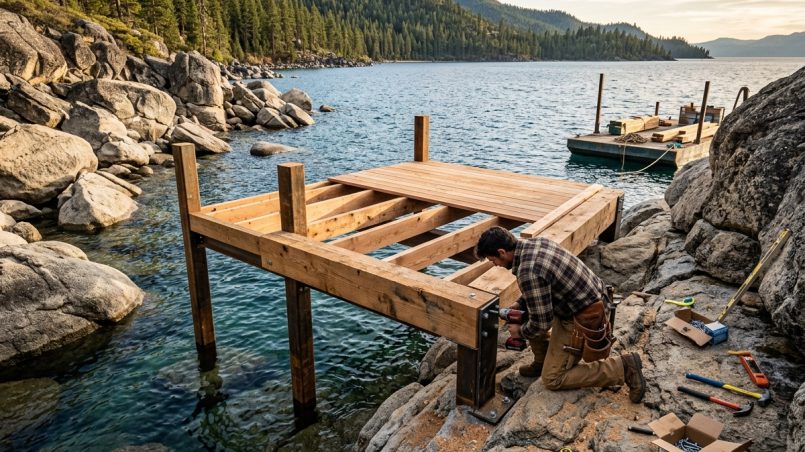
Irregular shorelines make dock planning less straightforward because the water’s edge may curve, slope, narrow, or change elevation over a short distance. Rocks, vegetation, retaining walls, shallow pockets, and uneven bottom conditions can further limit usable space. A boat dock builder usually starts by studying these details on site, then adjusts the dock position and layout around the property rather than trying to force a standard design into a difficult shoreline.
Reading the Shoreline Before Designing the Dock
A curved or uneven shoreline rarely has one obvious starting point. Builders look for a location that provides practical access from the property while also leading toward usable water.
The condition of the bank matters. A steep slope may require stairs or a longer gangway. A rocky edge may limit where shore connections can be placed. On softer banks, erosion or unstable soil may influence how close certain components can sit to the water. Existing seawalls, trees, landscaping, and drainage paths also need to be considered before the final position is chosen.
Following the Water Depth, Not Just the Shore
An irregular shoreline often continues below the surface. One section may drop quickly into deeper water while another stays shallow for a considerable distance.
A builder may take depth measurements at several points to find the most practical route offshore. This can change the dock angle. Instead of extending straight out from the property, the structure may be positioned slightly to one side to reach better boating depth or avoid rocks and submerged obstacles.
Seasonal water changes are part of the same discussion. Floating dock builders often look at normal high and low levels so the system remains useful through expected changes.
Adjusting the Dock Shape
Straight docks work well on many properties, but irregular shorelines sometimes benefit from a different configuration. L-shaped, T-shaped, or offset layouts can provide more useful space without requiring a long structure extending directly offshore.
The layout should still be kept as simple as practical. Extra turns and platforms add material and can affect installation, maintenance, and cost. A builder will usually try to solve the shoreline problem with the least complicated arrangement that still provides safe boat access.
Using Gangways to Handle Elevation Changes
A gangway can help connect a fixed shore point to an aluminum floating dock where the bank and water sit at different elevations. Its length and position influence the walking angle, particularly as water levels rise and fall.
On an irregular bank, the most convenient shore connection may not line up with the ideal location of the floating platform. A gangway can bridge that difference. The builder may shift the dock slightly offshore or sideways so people have a safer route while boats still have enough water around them.
Working Around Rocks, Vegetation, and Structures
Natural and existing features can shape the project more than property owners expect. Large rocks may interfere with supports or anchoring. Mature trees can restrict installation access. Retaining walls, boat ramps, neighboring docks, and shoreline landscaping may reduce the available area.
Removing every obstacle isn’t always necessary or desirable. Experienced contractors often look for ways to place the dock around existing conditions instead. Owners comparing aluminum docks or browsing aluminum boat docks for sale should keep this in mind. A system’s listed dimensions may work on paper but still need adjustment once real shoreline features are considered.
Accounting for Wind, Waves, and Boat Approach
The shape of the shore can create sheltered pockets in one area and greater exposure in another. A builder will often look at prevailing wind, wakes, current, and the direction boats normally approach the property.
These conditions can affect dock orientation. Placing a dock in the easiest construction location may not make sense if it leaves the boat exposed to regular wave action or makes docking difficult. The final position should work from both the land and water sides.
Building a Layout Around the Actual Property
Irregular shorelines don’t necessarily require unusually complicated docks. They do require careful measurements and a willingness to adapt the layout. Water depth, bank shape, boat clearance, shore access, and nearby obstacles usually matter more than fitting the dock into a perfectly straight line.
Property owners dealing with these conditions can benefit from speaking with an experienced boat dock builder before selecting dimensions or ordering components. Flotation Systems Inc. is one resource for those considering floating or fixed aluminum dock systems. Professional site input can help turn an awkward shoreline into a practical dock plan without adding features that the property doesn’t actually need.